 AWExpeditions
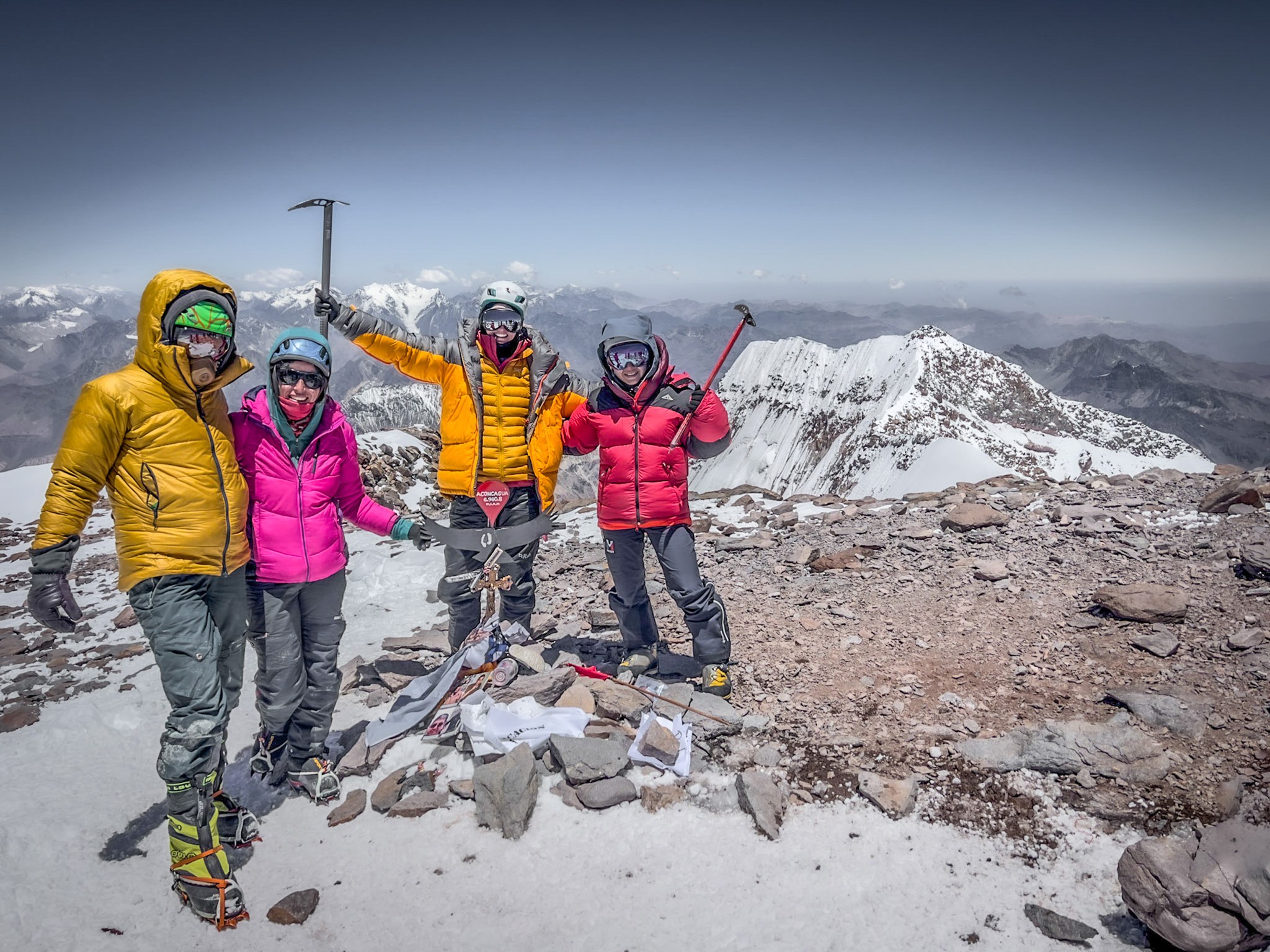
Mendoza, Argentina
6,961 m / 22,838 ft · Argentina
Aconcagua Normal Route
Handbook
For Women, By Women | AWExpeditions
Route at a glance
8,500 ft · 2,591 m Confluencia
11,000 ft · 3,353 m Plaza de Mulas
14,100 ft · 4,298 m Camp I
16,300 ft · 4,968 m Camp II
18,000 ft · 5,486 m Camp III
19,200 ft · 5,852 m Summit
22,838 ft · 6,961 m Plaza de Mulas
14,100 ft · 4,298 m
Welcome to Aconcagua
Aconcagua is 6,961 meters (22,838 ft), the highest point in the Americas, and the highest mountain outside Asia. There’s no technical climbing on our route, just one short glaciated section that usually doesn’t need a rope, which is why people call it a walk-up. It isn’t one. Cold, wind and altitude make it one of the hardest things you can ask of your legs and lungs.
We take the Normal Route, the most traveled way up the mountain. It follows the Horcones Valley to base camp at Plaza de Mulas, 4,300 meters (14,100 ft), then climbs through three camps to the summit. It’s a day shorter than our 360 and gains its height over fewer days, so it isn’t easier, just different. One practical difference: because this route goes up and back down the same way, a climber who needs to stop can head down on their own, rather than needing the whole team to reach a certain point first, which is what the 360’s loop requires.
This handbook is your one stop resource for getting ready: training, gear, insurance, the daily plan and the questions people ask most. Read it start to finish, then keep it on hand as you pack and train. We always try to give you clear, accurate information, but we’re not infallible. If anything here is unclear or looks wrong, tell us at info@awexpeditions.org.
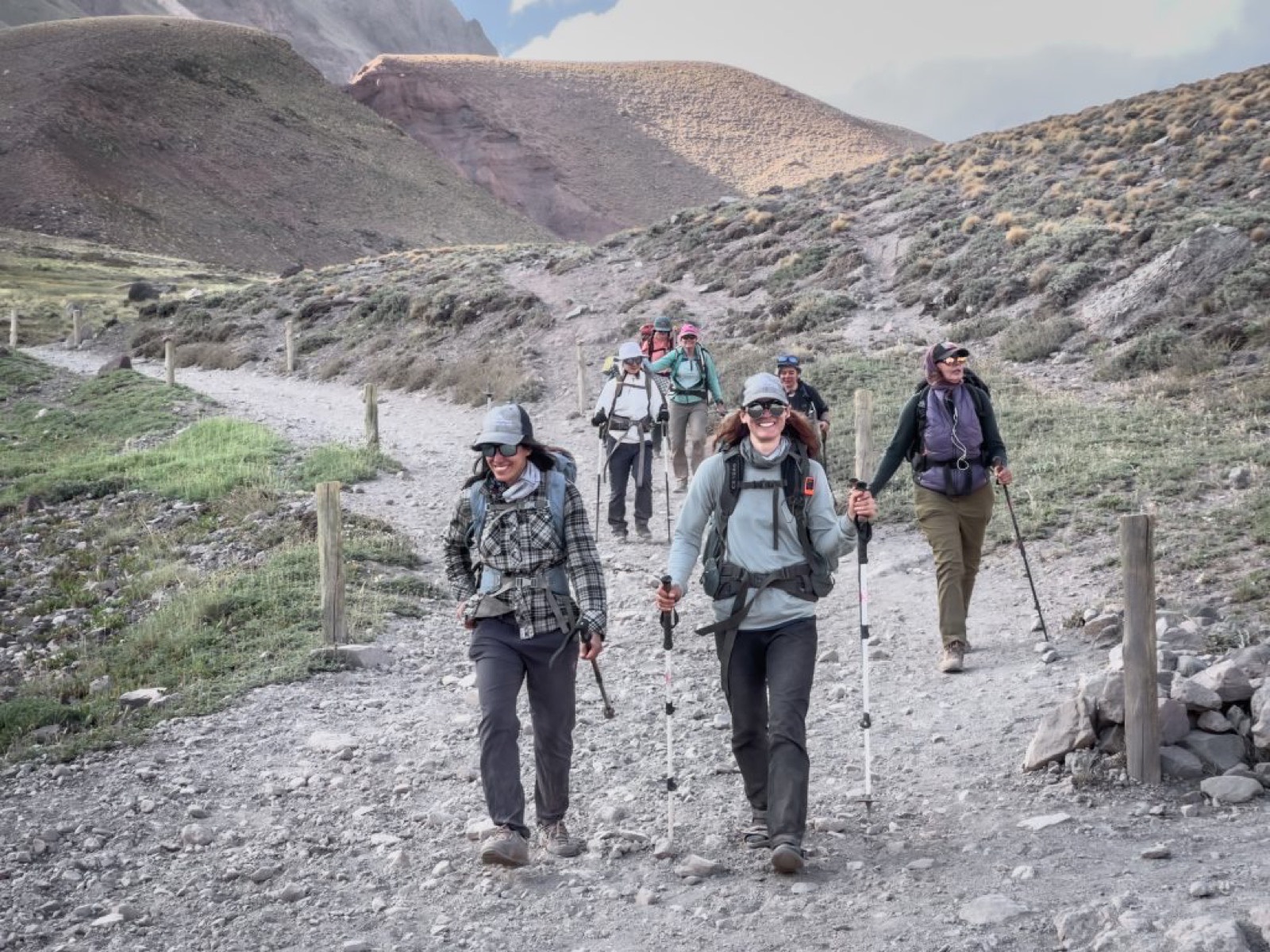 An AWE team on the trail into base camp, Horcones Valley.
Your one-page checklist
If you read nothing else, read and act on this.
- Training completed. Cardio and strength, well before departure. This expedition is harder than it looks on paper.
- Travel to Mendoza arranged. Know your arrival flight and when the welcome dinner is.
- Rescue insurance obtained and proof sent to us. It’s mandatory. See Insurance requirements below.
- Gear packed. Check it against the gear list and sort out rentals early.
- Trail snacks sorted. We cover meals on the mountain, but you bring your own trekking snacks for the carries and summit day.
- Personal medications and a small first aid kit ready. Blister care, any prescriptions you need, enough for three weeks.
- Medical history shared with us. Respiratory issues, heart conditions, diabetes, migraines, recent hospitalizations: tell us before the trip.
- The Aconcagua affidavit signed. You’ll sign this in Mendoza; Argentina requires it to enter Aconcagua Provincial Park.
- Sense of humor and team spirit packed. You’ll need it more than you think around Camp II.
About AWExpeditions
AWExpeditions was born out of a simple idea: to create space for women in mountaineering. Historically, men have led most of the field, leaving women with fewer opportunities to lead, learn and thrive in these environments. AWE exists to flip that script.
We work together. We lift one another up. We show up for ourselves and for our teammates when things get difficult, and we’re prepared and flexible when the mountain asks for it. Diversity is our strength, and it guides how we approach our teammates, guides, staff and local partners. Creating a safe space for everyone is at the heart of what we do.
About your guides
Aconcagua is run by AWE founder Sunny Stroeer and our local partner, INKA Expediciones. Sunny has more than ten years of experience on Aconcagua. She has climbed it solo and unsupported, set speed records on it, and has led AWE’s Aconcagua teams every season since 2016.
Your leadership team pairs an AWE expedition leader with experienced Argentine mountain guides from INKA Expediciones, who know the Normal Route, the weather patterns and the mountain’s moods better than anyone. That local knowledge, and INKA’s logistics on the ground in Mendoza and on the mountain, is part of what your expedition fee covers.
Get ready: Aconcagua Prep School
Before you train on your own, consider Aconcagua Prep School, AWE’s own six-part webinar series hosted by Sunny on acclimatization, extreme cold, physical and mental preparation, route logistics, gear and food, and the most common mistakes climbers make. It covers both the 360 and the Normal Route, and it’s free for anyone on an AWE Aconcagua team.
Training
Training is essential for safety, success and enjoyment. This isn’t an expedition to tackle with untrained legs, and an unprepared climber can put the whole team’s pace and plans at risk. Start well in advance of your departure.
Train for endurance and strength, with a focus on carrying weight uphill. Hiking on steep, uneven terrain with a loaded pack is the closest simulation to what you’ll face on Aconcagua. As a rough benchmark, many climbers preparing for Aconcagua work toward being able to hike six to eight hours with a heavy pack, then do it again the next day, without feeling wrecked at the end.
AWE partners with Uphill Athlete, widely regarded as the gold standard for mountaineering fitness, at special pricing for AWE climbers. Combine that with Aconcagua Prep School for the mountain-specific pieces: acclimatization strategy, cold management and what the carries actually feel like.
Altitude
Plaza de Mulas, our base camp on the Normal Route, sits above 4,300 meters (14,100 ft), and the summit is 6,961 meters (22,838 ft). The higher you go, the less oxygen is in each breath, and that affects everyone differently. Fitness doesn’t decide this: altitude sickness, or Acute Mountain Sickness (AMS), can strike anyone. There’s no reliable predictor other than your own history at altitude.
Ascending too quickly increases the risk of AMS. If you develop symptoms serious enough that your guides judge it dangerous, you’ll need to descend on their call, without room for argument. Descending is the only reliable cure; the sooner you do it, the less likely AMS is to advance into potentially fatal HACE (High Altitude Cerebral Edema) or HAPE (High Altitude Pulmonary Edema).
Mild AMS is usually treated with rest, fluids and mild analgesics like ibuprofen or acetaminophen. Most people improve within a day or two at the same altitude, sometimes longer. Some climbers use Diamox (acetazolamide) to help the body acclimatize; see the FAQ below for how we think about that, and talk to your doctor before your trip.
Daily itinerary
Weather, snow and the team’s pace can all move this around. Your guides make the calls that matter, especially above base camp.
| Day | Plan |
|---|---|
| 1 | Arrival in Mendoza, Argentina; welcome dinner |
| 2 | Gear check and transfer to Penitentes |
| 3 | Trek to Confluencia |
| 4 | Acclimatization hike to Plaza Francia |
| 5 | Trek from Confluencia to Plaza de Mulas (8 to 9 hours) |
| 6 | Rest day at Plaza de Mulas, 14,100 ft (4,300 m) |
| 7 | Carry to Camp I |
| 8 | Rest day |
| 9 | Move to Camp I, 16,300 ft (4,970 m) |
| 10 | Carry to Camp II |
| 11 | Move to Camp II, 18,000 ft (5,490 m) |
| 12 | Carry to Camp III, 19,200 ft (5,850 m) |
| 13 | Rest day |
| 14 | Move to Camp III |
| 15 | Summit day, 22,838 ft (6,961 m) |
| 16 | Reserve summit day |
| 17 | Descend to Plaza de Mulas, 14,100 ft (4,300 m) |
| 18 | Trek to Penitentes (about 15 miles) |
| 19 | Transfer to Mendoza and final dinner |
| 20 | Depart Mendoza |
Route and elevation
The chart above is your whole expedition at a glance. The pattern you’ll see again and again, carry a load up, sleep back down, then move camp, is how we acclimatize safely. Here’s that same climb broken into its real segments:
- Penitentes (about 8,500 ft (2,600 m)) to Confluencia camp (about 11,000 ft (3,400 m)). One trekking day up the Horcones Valley to the first camp.
- Acclimatization hike to Plaza Francia (about 13,800 ft (4,200 m)) and back down to Confluencia. A day hike that gets you briefly above 13,000 ft (4,000 m) before you sleep low again, with a view of Aconcagua’s south face along the way.
- Confluencia to Plaza de Mulas base camp (14,100 ft / 4,300 m). An 8 to 9 hour trekking day.
- Base camp to Camp I (16,300 ft / 5,000 m). About 2,200 ft (700 m) of gain, done as a carry day followed by a move day, with a rest day at base camp first.
- Camp I to Camp II (18,000 ft / 5,500 m). About 1,700 ft (500 m) of gain, same carry-then-move rhythm.
- Camp II to Camp III (19,200 ft / 5,900 m). About 1,200 ft (400 m) of gain, the last camp before the summit push.
- Camp III to the summit (22,838 ft / 6,961 m) and back. About 3,600 ft (1,100 m) of climbing, round trip in a single long day. This is usually the hardest day people have had, physically, and we hold a reserve day in case weather pushes the summit attempt back.
- Descent to Plaza de Mulas (14,100 ft / 4,300 m) and out to Penitentes. We come down the same way we went up, so a trekking day down to base camp, then about 15 miles out to Penitentes on the final day.
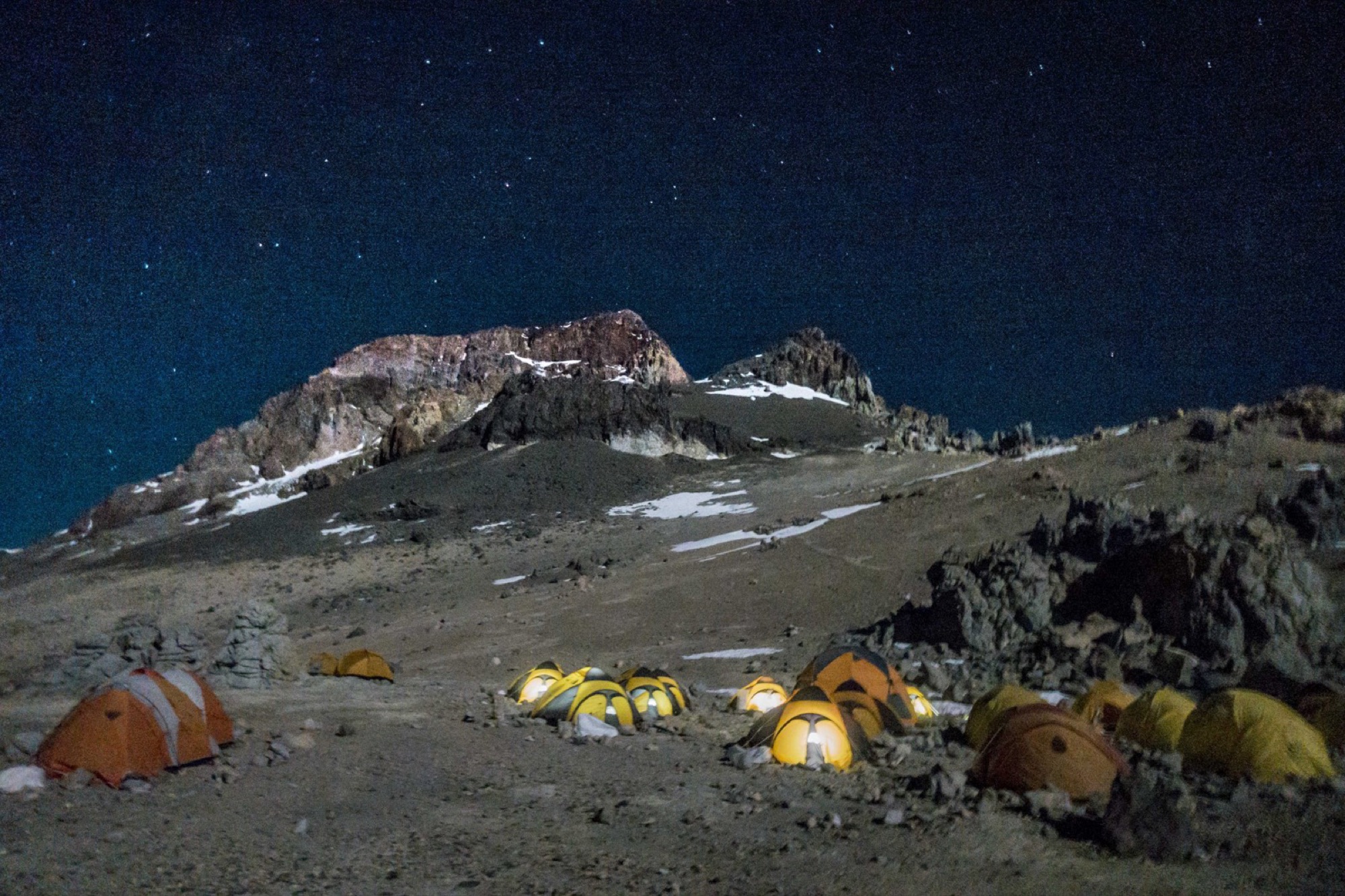 Camp at night, high on the mountain.
Gear
Everything here is required unless we’ve told you otherwise. Rentals are available in Mendoza for the big-ticket items; ask us early so we can help arrange it.
- Double mountaineering boots
- Ice axe, crampons and climbing helmet
- Sleeping bag, rated to -20F or -40F
- 65-liter-plus backpack
- Sleeping pads
- Expedition-weight down jacket
- Hardshell (Gore-Tex) jacket
- High-altitude mittens
Pack light where you can. Between the gear above and your share of team gear, your pack will be heavy no matter what. Bring a small duffel bag for town clothes you can leave at the Mendoza hotel while you’re on the mountain.
What’s included and what isn’t
Included:
- Hotel nights in Mendoza with breakfast
- Welcome dinner and celebration dinner
- All meals on the mountain, including water and coffee or tea
- Group transfers from the Mendoza airport and between Mendoza and the trailhead
- Guide team: an AWE expedition leader and local Argentine guides
- Team gear: four-season tents (two per tent), cooking gear, team medical kit
- GPS tracking and communications on the mountain
- Mule support up to 20 kg per person to base camp
Not included:
- Flights to and from Mendoza
- Government climbing permit, paid on arrival
- Other lunches and dinners in Mendoza
- Personal mountaineering gear
- Tips for guides
- Drinks other than water, coffee and tea
- Trail snacks
- Personal medications
- Medical, travel and rescue insurance
- Single room (ask us about availability and price)
- Porter support above base camp, if you want it
Deposit: $500 to reserve. The balance is due in two payments, 90 and 60 days before departure.
Insurance requirements
Preparing for a big adventure means planning for the unexpected. There are two kinds of relevant insurance: travel insurance and rescue (evacuation) insurance. Rescue insurance is mandatory. Travel insurance is highly recommended but your own decision.
Travel insurance. What happens if you sprain an ankle the week before your trip, your car breaks down, or your checked bag with all your mountaineering gear doesn’t arrive on time? We’ve seen all of those scenarios happen. We don’t have a preferred provider, but consider a Cancel For Any Reason policy, which typically lets you recoup your expedition fees and travel costs even if you have to cancel for a reason like a job change or a family matter. We don’t require proof of travel insurance; it’s your own decision.
Rescue insurance. In the event of an emergency, you need coverage that includes helicopter or mule evacuation to avoid the high costs of a rescue operation on Aconcagua. Global Rescue is a trusted leader in mountaineering and backcountry travel protection, with comprehensive policies that include both travel and rescue coverage. For a more affordable, basic option, consider joining the American Alpine Club; partner-level membership includes up to $7,500 in trailhead rescue benefits, which satisfies the rescue insurance requirement for this expedition, though it isn’t as comprehensive as a dedicated policy. We do require proof of rescue insurance: please send your policy details to info@awexpeditions.org before the trip.
The Aconcagua affidavit. On arrival in Mendoza, Argentina requires every climber to sign a risk acceptance affidavit for Aconcagua Provincial Park. It states that you accept responsibility for your own safety in the park, and for any costs of rescue, evacuation or medical care that come up. This is a government requirement, not an AWE policy, and it’s part of why rescue insurance matters.
Questions? Get in touch.
info@awexpeditions.org · 833-252-5293 Sunny Stroeer, Founder and Expedition Leader: sunny@awexpeditions.org Shea McCrary, General Manager: shea@awexpeditions.org
Frequently asked questions
How is this different from the 360?
Same mountain, same summit, similar difficulty. The Normal Route approaches through the Horcones Valley to Plaza de Mulas and is a day shorter. The 360 takes the quieter Vacas Valley and loops the mountain, with an extra day for acclimatization. For most climbers we recommend the 360.
What happens if I can't keep going?
The Normal Route goes up and back down the same way, so a climber who needs to stop can head down on their own schedule, with support, rather than needing the whole team to reach a certain point first. That's the main practical difference from the 360, which is a loop.
How fit do I need to be?
Very. Plan on six to eight hours a day with a heavy pack, at altitude, for days in a row. We'll help you build a training plan.
Is it technical?
No technical climbing and no steep ice. There's one short glaciated section that usually doesn't need a rope, and you'll carry crampons and an ice axe for it and for hard snow. It's hard because of the altitude, the length and the weather. Summit day is often the hardest physical day people have had.
How much will I carry?
About 20 pounds to base camp, because mules carry the rest. Above base camp, 35 to 40 pounds on each carry, and up to 65 on the way down after the summit. Porters can be hired above base camp if you want to lighten that; budget $1,000 or more for 20 kg there and back.
Should I take Diamox (acetazolamide)?
That's a decision for you and your doctor. Plenty of climbers summit without it. How well you acclimatize is mostly genetic, and the best predictor is how you've done at altitude before. If you've never been this high, Diamox can improve your odds, but it has side effects and takes a day or two to start working. It's also a diuretic, so hydrate more if you take it.
Can I have my own room?
Usually, for an extra fee, in Mendoza. Ask us about availability and price for your dates.
Have you been hospitalized in the last year, or do you have any medical conditions we should know about?
Tell us before the trip, not on it. Respiratory problems, heart conditions, diabetes, chronic headaches or migraines, and recent hospitalizations all matter at altitude. This isn't disqualifying on its own, it just needs to be part of the plan, so we can plan around it with you and your guides.
What's the food like?
Real meals at Mendoza hotels and base camp, and energy-dense mountaineering food above it: hot breakfasts and dinners, soups, and dehydrated meals on the higher carries. We can accommodate vegetarian, vegan, gluten-free, celiac and dairy-free diets with advance notice. Bring your own trail snacks for summit day and the carries; we don't supply those.
What's the bathroom situation above base camp?
Waste bags (WAG bags) above base camp, which is standard practice on Aconcagua to protect the mountain. We'll brief you on the system before you need it.
Will I have phone service or Wi-Fi?
No cell service above Mendoza. We carry GPS tracking and satellite communication for the team and for emergencies, but personal calls and texts aren't part of that. Tell the people at home not to expect to hear from you for three weeks.
Do I need a visa?
Check your own country's requirements for Argentina before you book your flights. Many nationalities, including US passport holders, don't need a visa for a short tourist stay, but this changes by nationality and we can't give you a blanket answer. Confirm with the Argentine consulate or embassy for your passport.
We're running this on request. What does that mean for me?
The Normal Route departs when a group of three or more climbers is ready to go, rather than on a fixed annual calendar. If you're putting a group together, or want to join one that's forming, write to us at info@awexpeditions.org and we'll help you find teammates or confirm a date.