 AWExpeditions
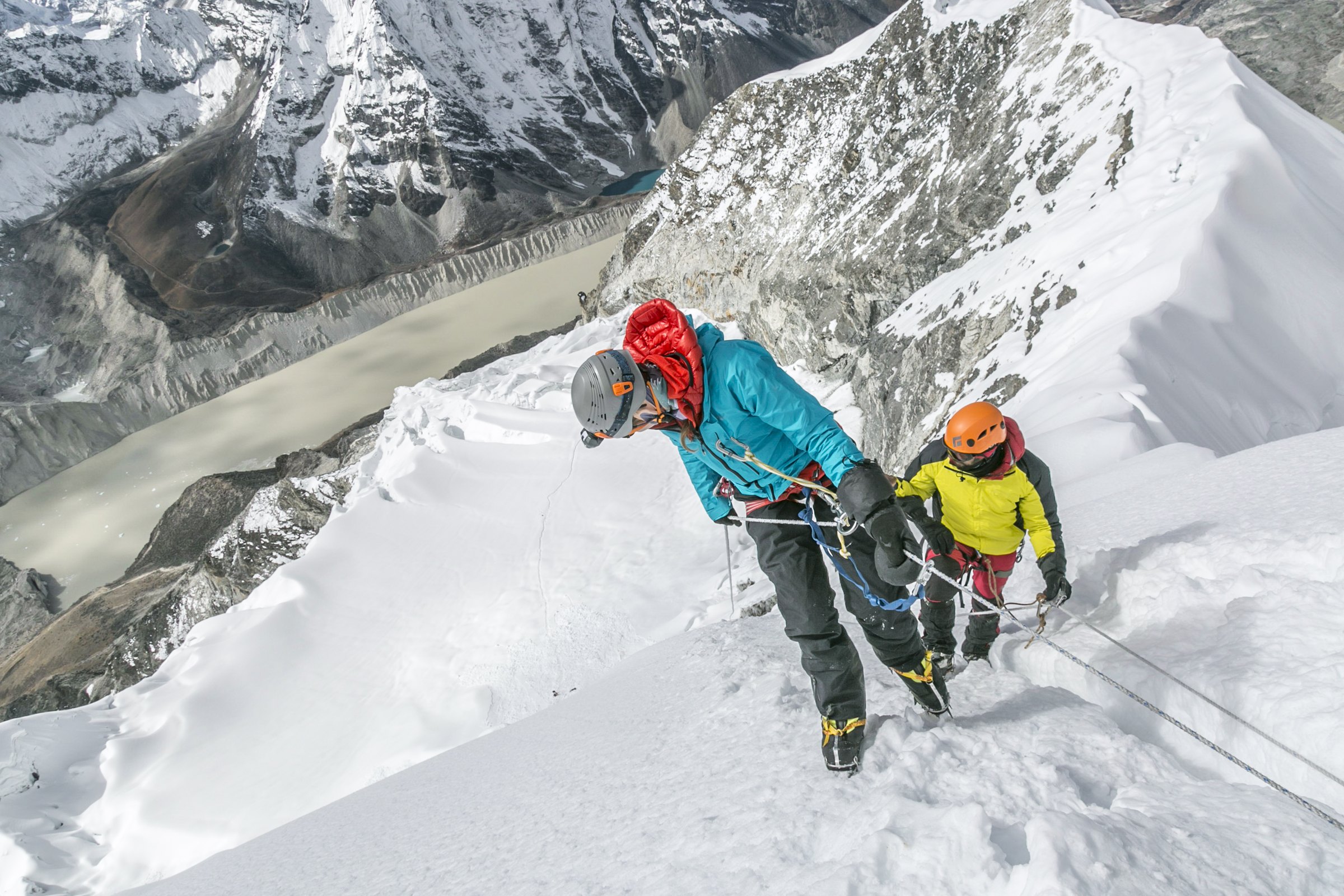
Khumbu, Nepal
5,545 m / 18,187 ft · Nepal
Nepal Passes and Peaks
Handbook
For Women, By Women | AWExpeditions
Route at a glance
4,500 ft · 1,372 m Phakding
8,713 ft · 2,656 m Namche Bazaar
11,318 ft · 3,450 m Thame
12,431 ft · 3,789 m Lungdhen
14,370 ft · 4,380 m Renjo La Pass
17,585 ft · 5,360 m Gokyo Lakes
15,583 ft · 4,750 m Gokyo Ri
17,988 ft · 5,483 m Dragnag
15,387 ft · 4,690 m Cho La Pass
17,782 ft · 5,420 m Dzonglha
15,846 ft · 4,830 m Lobuche
16,174 ft · 4,930 m Kala Patthar
18,187 ft · 5,543 m Everest Base Camp
17,600 ft · 5,364 m Kongma La Pass
18,159 ft · 5,535 m Chhukung
15,518 ft · 4,730 m Tengboche
13,074 ft · 3,985 m Namche Bazaar
11,286 ft · 3,440 m Lukla
9,186 ft · 2,800 m Kathmandu
4,428 ft · 1,350 m
Welcome to the Khumbu
This is not the standard Everest Base Camp trek. It takes the long way, over high passes above 5,300 meters (17,400 ft) and through the Thame and Gokyo valleys, where far fewer trekkers go. The route crosses three named passes, Renjo La, Cho La and Kongma La, and reaches Everest Base Camp and the Kala Patthar viewpoint along the way.
The first week is for acclimatizing around Namche Bazaar and Thame. Then the high days come close together: the passes, the Gokyo valley, and Everest Base Camp country. Pass days run seven to ten hours, with up to 3,500 feet (1,100 m) of climbing and more going down. We’re confirming the exact 2027 route and whether Lobuche East, a 6,119-meter (20,075-foot) peak, is included as the climbing component with Jeannette now; applicants hear first once it’s locked.
This handbook is your one stop resource for getting ready: training, altitude, the daily plan and the questions people ask most. The itinerary below reflects the general shape of AWE’s Three Passes route from a past team; your 2027 dates and exact stops may vary once finalized. Read it start to finish, then keep it on hand as you pack and train. We always try to give you clear, accurate information, but we’re not infallible. If anything here is unclear or looks wrong, tell us at [email protected].
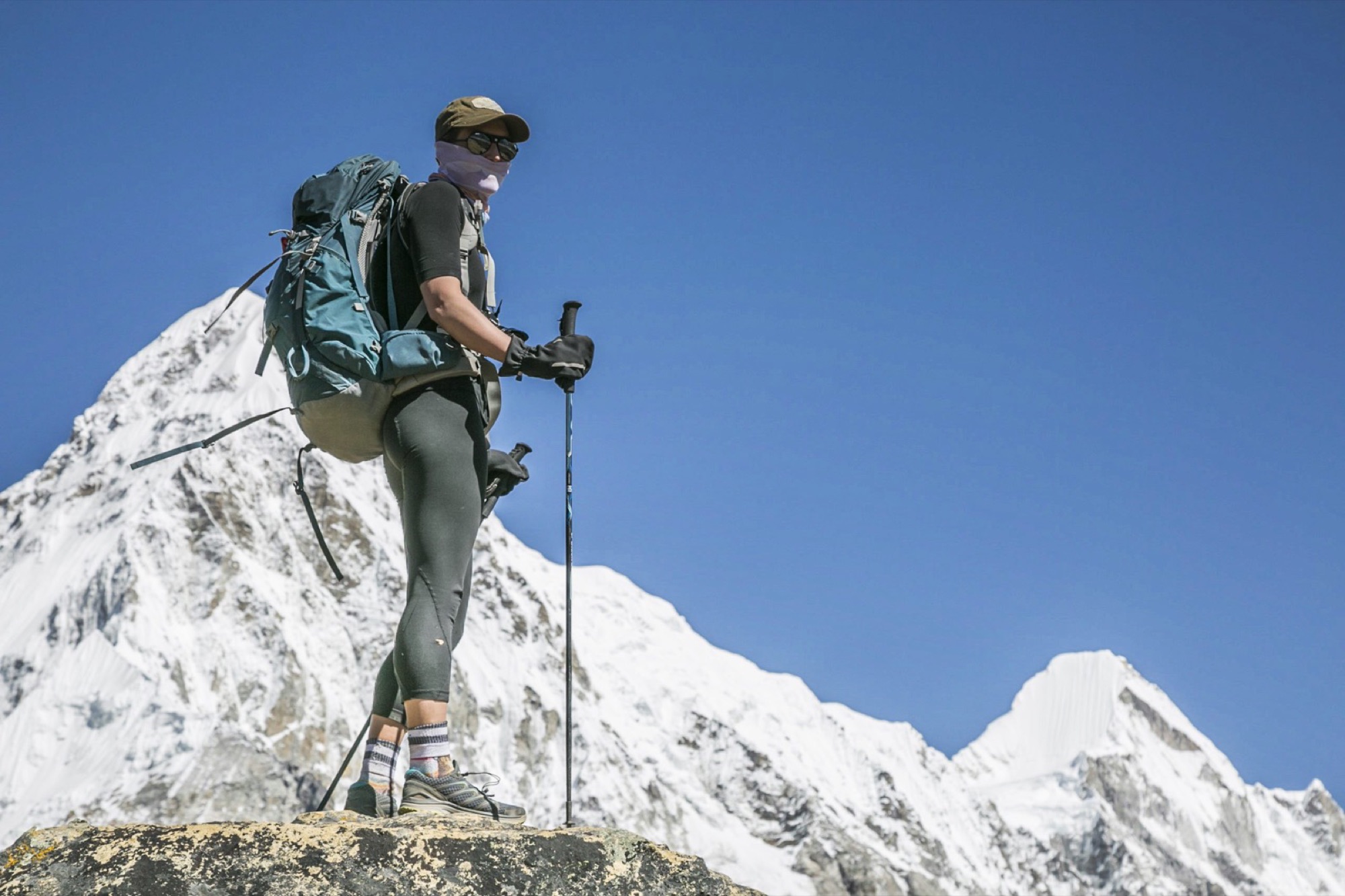 On the trail in the Khumbu region.
Your one-page checklist
If you read nothing else, read and act on this.
- Training completed. Cardio, strength and uphill work, well before departure. This isn’t a trail to tackle with untrained legs.
- Flights to Kathmandu booked. Monitor fares to find a good deal.
- Visa and passport in hand. Visitors to Nepal need a tourist visa; arrange it ahead of time where you can.
- Rescue insurance obtained and proof sent to us. It’s mandatory and needs to cover altitudes above 14,000 ft (4,300 m) and helicopter evacuation. See Insurance requirements below.
- Gear packed. Check it against the gear list and sort out rentals early.
- Trekking snacks prepared. Bring a minimum of 3,500 calories of your own snacks.
- Personal medications ready. Including a personal prescription for Diamox (acetazolamide), if you and your doctor decide it’s right for you.
- Sense of adventure on board.
About AWExpeditions
AWExpeditions was born out of a simple idea: to create space for women in mountaineering. Historically, men have led most of the field, leaving women with fewer opportunities to lead, learn and thrive in these environments. AWE exists to flip that script.
We work together. We lift one another up. We show up for ourselves and for our teammates when things get difficult, and we’re prepared and flexible when the mountain asks for it. Diversity is our strength, and it guides how we approach our teammates, guides, staff and local partners. Creating a safe space for everyone is at the heart of what we do.
About your guides
This trip is led by Dr. Jeannette McGill of McGill’s Mountains, who summited Everest in 2025 and was the first South African woman to summit Manaslu. She’s led this route before and works with a Nepali sirdar and local team who know the Khumbu’s trails, teahouses and seasonal conditions.
Training
Trekking in the mountains is hard, particularly when it involves crossing a pass above 17,000 feet (5,200 m). Training is essential for safety, success and enjoyment. Start well in advance of your departure; an unprepared trekker affects the whole team’s pace and plans.
Train for endurance and strength as multiple consecutive days of high-output activity. Hiking on steep, hilly terrain with a loaded pack is the closest simulation to what you’ll face. As a baseline, aim to complete a trail half marathon, or hike about 15 miles carrying 20 pounds in a single day, without feeling completely wrecked at the end.
AWE partners with Uphill Athlete, widely regarded as the gold standard for mountaineering fitness, at special pricing for AWE climbers.
Altitude
Kathmandu sits at about 4,500 feet (1,400 m) above sea level; the high point of this trek exceeds 18,000 feet (5,500 m). If you haven’t been above 14,000 feet (4,300 m) before, read this section carefully.
The higher you go, the less oxygen is in each breath, and that affects everyone differently. Fitness doesn’t decide this: altitude sickness, or Acute Mountain Sickness (AMS), can strike anyone. There’s no reliable predictor other than your own history at altitude.
Ascending too quickly increases the risk of AMS. If you develop symptoms serious enough that your guides judge it dangerous, you’ll need to descend on their call, without room for argument. Descending is the only reliable cure; the sooner you do it, the less likely AMS is to advance into potentially fatal HACE (High Altitude Cerebral Edema) or HAPE (High Altitude Pulmonary Edema).
Mild AMS is usually treated with rest, fluids and mild analgesics like aspirin, ibuprofen or acetaminophen. Improvement usually happens in a day or two, sometimes three or four. Some trekkers use Diamox (acetazolamide) to help the body acclimatize; it takes about 24 to 48 hours to start working and is a diuretic, so you’ll need to hydrate more if you take it. Talk to your doctor before your trip, especially if you’ve never slept above 10,000 feet (3,000 m) or are traveling to Kathmandu from sea level.
Daily itinerary
This reflects the general shape of a past AWE Three Passes route. Your team’s exact 2027 itinerary, including whether Lobuche East is part of it, is still being finalized with Jeannette. Weather, trail conditions and the team’s pace can all move days around once confirmed.
| Day | Plan |
|---|---|
| 1 | Trip briefing, gear check and shopping in Kathmandu; welcome dinner |
| 2 | Fly to Lukla; trek to Phakding, 8,713 ft (2,656 m) |
| 3 | Acclimatization walk and visit to a local monastery |
| 4 | Trek to Namche Bazaar, 11,318 ft (3,450 m) |
| 5 | Acclimatization walk; lunch at Everest View Hotel |
| 6 | Trek to Thame, 12,431 ft (3,789 m); evening visit to Thame Monastery |
| 7 | Acclimatization walk partway up Sunder Peak |
| 8 | Trek to Lungdhen, 14,370 ft (4,380 m) |
| 9 | Over Renjo La Pass, 5,360 m (17,590 ft), to Gokyo Lakes village |
| 10 | Acclimatization ascent of Gokyo Ri for sunrise views |
| 11 | Trek across the glacier to Dragnag |
| 12 | Over Cho La Pass, 5,420 m (17,780 ft), to Dzonglha |
| 13 | Trek to Lobuche village |
| 14 | Trek to Gorak Shep; ascent of Kala Patthar, 18,187 ft (5,543 m) |
| 15 | Trek to Everest Base Camp, return to Lobuche |
| 16 | Contingency day for weather |
| 17 | Over Kongma La Pass, 5,535 m (18,159 ft), to Chhukung |
| 18 | Rest day, or optional walk to Island Peak Base Camp |
| 19 | Trek to Tengboche; visit the monastery |
| 20 | Trek to Namche Bazaar |
| 21 | Trek to Lukla; final team dinner |
| 22 | Fly back to Kathmandu |
| 23 | Departure day |
Route and elevation
The chart above traces all three named passes, the reason this trek carries that name. The real shape of it:
- Kathmandu (4,500 ft / 1,400 m) to Namche Bazaar (11,318 ft / 3,450 m). Several trekking days up the Dudh Kosi valley, crossing high suspension bridges, with acclimatization days built in.
- Namche to the Renjo La Pass (5,360 m / 17,585 ft) and down to Gokyo. The first of the three passes, with an acclimatization ascent of Gokyo Ri (17,988 ft / 5,483 m) for sunrise views of Everest, Lhotse and Makalu.
- Gokyo to the Cho La Pass (5,420 m / 17,782 ft) and down to Lobuche. Varied terrain with steel cables for support across a lateral moraine, the second pass.
- Lobuche to Everest Base Camp via Kala Patthar (5,545 m / 18,187 ft), the trek’s high point. A side trip to EBC itself and back, then on toward the final pass.
- Over the Kongma La Pass (5,535 m / 18,159 ft) to Chhukung. The third and final named pass, descending into the Imja Khola valley.
- Chhukung back to Lukla. A multi-day descent through Tengboche and Namche Bazaar, then a short flight back to Kathmandu.
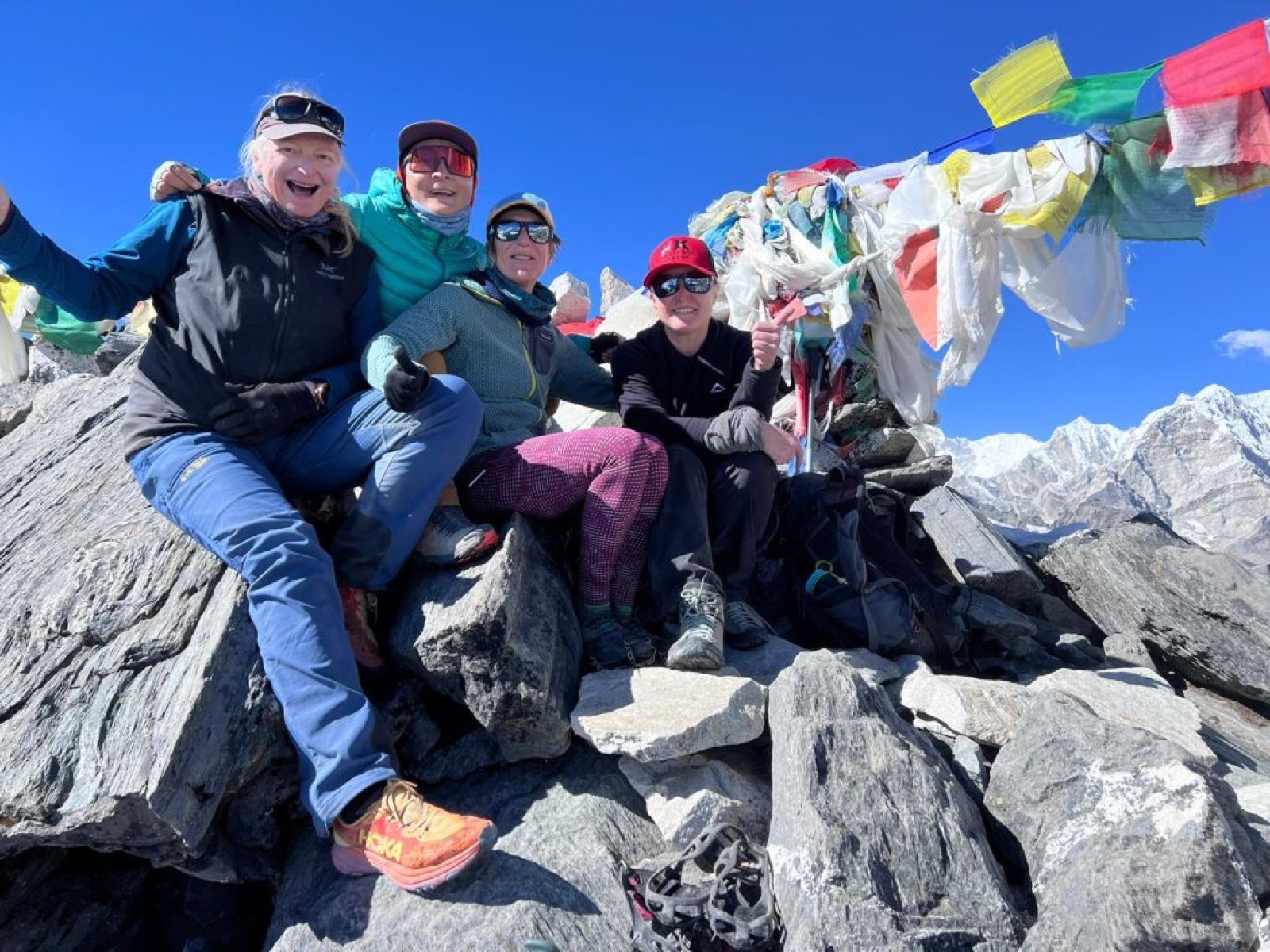 Crossing one of the three passes.
Gear
Everything here is required unless we’ve told you otherwise. Rentals for sleeping bags, sleeping pads and trekking poles can be arranged in Kathmandu; email [email protected] ahead of time so we can confirm availability and pricing.
- Hiking boots
- Trekking poles
- 40-liter-plus backpack
- 0°F sleeping bag
- Sleeping pad
- Glacier glasses
- Backpacking attire, including a warm down jacket
- Wind and waterproof Gore-Tex jacket
- Gloves
Beyond your trekking backpack, bring a large, sturdy duffel bag for your main checked luggage (your trekking backpack and gear should fit inside it), and a small town bag for anything you’d rather leave at the hotel in Kathmandu.
What’s included and what isn’t
Included:
- All international airport and hotel transfers in Kathmandu
- 3 nights accommodation in a 3-star hotel in Thamel, Kathmandu (2 pre-trail, 1 post-trail)
- Welcome and cultural dinner in Kathmandu
- Teahouse and tented accommodation during trekking
- Breakfasts in Kathmandu and three meals a day in the mountains
- Ground transportation by private vehicle to and from the domestic airport
- Full staff team: an English-speaking climbing leader (guide/sirdar), cook and Sherpa porters to carry duffels and equipment, including their salary, insurance, equipment, flights, food and lodging
- All domestic flights (Kathmandu to Lukla to Kathmandu)
- All necessary paperwork: TIMS card and Sagarmatha National Park fee
Not included:
- Nepal visa fee (bring US$50 cash and two passport photographs as a backup)
- International airfare to and from Kathmandu
- Altitude chamber (PAC) or oxygen
- Medical, travel and rescue insurance, with helicopter and high-altitude evacuation coverage required
- Personal trekking equipment (good quality gear can be rented in Kathmandu if needed)
- Personal expenses (phone, internet, laundry, hot showers, extra porters, bottled water, snacks), roughly $20 to $30 a day
- Personal medications
- Optional side trips or extended sightseeing
- Tips for local guides and porters, approximately $400
- Single supplement, ask us about availability and price
Insurance requirements
Insurance is essential for a trip this size. Rescue insurance is mandatory. We also strongly recommend travel insurance.
Travel insurance. Given the cost of a trip like this, consider a policy that covers trip interruptions, lost gear and cancellations. It can also help with off-trail costs if you get sick and have to leave the trek early.
Rescue insurance. Your personal rescue (evacuation) insurance is mandatory and needs to cover altitudes above 14,000 ft (4,300 m) as well as helicopter evacuation. Global Rescue is a trusted leader in mountaineering and backcountry travel protection, with policies that combine travel and evacuation insurance. For a more affordable, basic option, consider joining the American Alpine Club; current members may receive up to $7,500 in trailhead rescue benefits, which satisfies the rescue insurance requirement for this trip, though it isn’t as comprehensive as a dedicated policy. We do require proof of rescue insurance: please send your policy details to [email protected] before the trip.
Questions? Get in touch.
[email protected] · 833-252-5293 Sunny Stroeer, Founder and Senior Expedition Leader: [email protected] Shea McCrary, General Manager: [email protected]
Frequently asked questions
How fit do I need to be?
You should be able to hike 10 to 12 miles with 5,000 feet (1,500 m) of climbing and still enjoy the next day. The pass days come close together near the end of the trip. As a baseline, aim to complete a trail half marathon, or hike about 15 miles carrying 20 pounds in a single day, without feeling completely wrecked at the end.
Do I need climbing gear?
Not for the trekking. For Lobuche East, if it's included on your team's trip, you'll need crampons, an ice axe, a harness and boots that take crampons, and we'll tell you what to rent locally.
How much will I carry?
A daypack of 20 to 25 pounds. Porters carry the duffels.
Is Lobuche East included?
Lobuche East is planned as part of the 2027 trip. We're finalizing the route and pricing with Jeannette now, and applicants hear first.
Can I hire extra porter help?
Yes. Ask us about cost.
Should I take Diamox (acetazolamide)?
That's a decision for you and your doctor. Plenty of trekkers summit without it. How well you acclimatize is mostly genetic, and the best predictor is how you've done at altitude before. If you've never been this high, Diamox can improve your odds, but it has side effects, including that it's a diuretic, so hydrate more if you take it. It takes about 24 to 48 hours before it starts helping your body compensate, so start it with enough lead time if you and your doctor decide it's right for you.
Do I need a visa for Nepal?
Yes, a tourist visa is required for most visitors. It's recommended to arrange this ahead of time; US residents can check the State Department's country page for Nepal for current requirements. Bring US$50 cash and two passport photographs as a backup in case you need to get your visa on arrival.