 AWExpeditions
Osh, Kyrgyzstan
7,134 m / 23,406 ft · Kyrgyzstan
Lenin Peak
Handbook
For Women, By Women | AWExpeditions
Route at a glance
11,811 ft · 3,600 m Camp 1
14,436 ft · 4,400 m Yukhin Peak
16,831 ft · 5,130 m Camp 2
17,388 ft · 5,300 m Camp 3
20,013 ft · 6,100 m Summit
23,406 ft · 7,134 m
Welcome to Lenin Peak
Lenin Peak sits on the border of Kyrgyzstan and Tajikistan at 7,134 meters (23,406 ft). For a 7,000-meter (23,000-foot) peak the logistics are simple: fly into Osh, drive to a base camp with hot showers and Wi-Fi, and start climbing. The climbing is the hard part.
Above Camp 1 you’re on glacier the whole way: roped travel, crevasse crossings, a few ladders, jumaring up fixed lines, and a summit day from Camp 3 at 6,100 meters (20,000 ft). Expect wind, snow camping and storms that build fast. We go up to Camp 3 once to acclimatize, come back down to rest at base camp, then go up again for the summit, with a spare day held for weather.
This handbook is your one stop resource for getting ready: training, gear, the daily plan and the questions people ask most. Read it start to finish, then keep it on hand as you pack and train. We always try to give you clear, accurate information, but we’re not infallible. If anything here is unclear or looks wrong, tell us at [email protected].
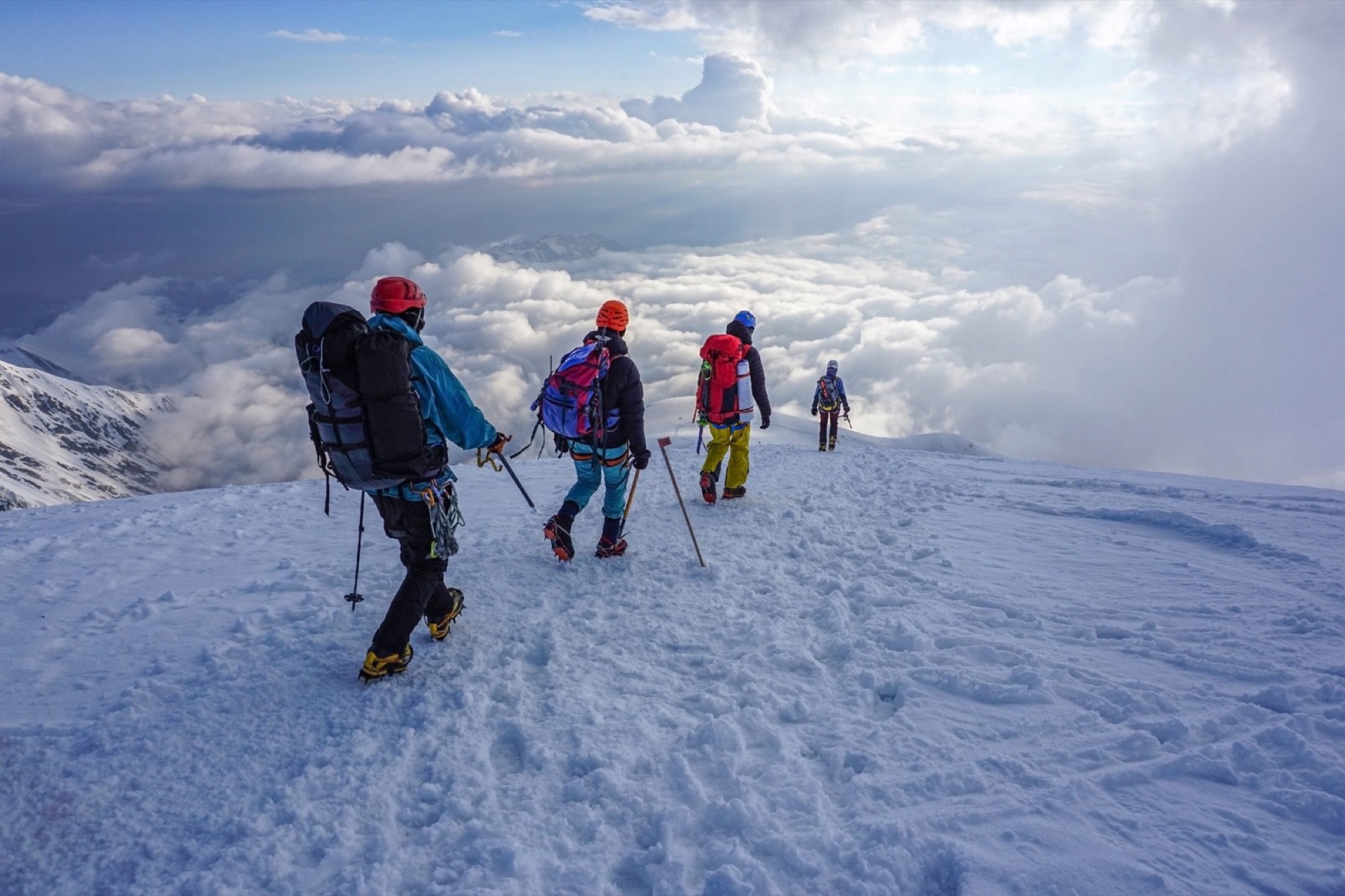 On the ridge, with the glaciers of Lenin Peak behind.
Your one-page checklist
If you read nothing else, read and act on this.
- Training completed. Cardio and strength, well before departure. This expedition is harder than it looks on paper.
- Travel to Osh arranged. Know your arrival flight and when the welcome dinner is.
- Rescue insurance obtained and proof sent to us. It’s mandatory. See Insurance requirements below.
- Gear packed. Check it against the gear list and sort out rentals early; crampons, ice axes, helmets and more can be rented locally through our logistics partner, but you need to ask us early to arrange it.
- Trail snacks sorted. We cover meals, but lunches aren’t always included on moving days, so bring about a pound of your own snacks per day, with extra for summit day.
- Personal medications and a small first aid kit ready. Blister care, any prescriptions you need, enough for three weeks.
- Visa checked. Confirm whether your passport needs one for Kyrgyzstan.
- Sense of humor and team spirit packed. You’ll need it more than you think on the second rotation.
About AWExpeditions
AWExpeditions was born out of a simple idea: to create space for women in mountaineering. Historically, men have led most of the field, leaving women with fewer opportunities to lead, learn and thrive in these environments. AWE exists to flip that script.
We work together. We lift one another up. We show up for ourselves and for our teammates when things get difficult, and we’re prepared and flexible when the mountain asks for it. Diversity is our strength, and it guides how we approach our teammates, guides, staff and local partners. Creating a safe space for everyone is at the heart of what we do.
About your guides
This expedition runs with AWE’s core team and our local partner, Asia Outdoors. Your leadership team pairs an AWE expedition leader with experienced local guide staff who know Lenin Peak’s route, camps and weather patterns. Priority for a spot on this trip goes to AWE alumnae with at least one prior expedition with us; if you’re new to AWE, we’ll talk through your experience with you before a spot is offered.
Training
Lenin Peak will test your endurance, strength and mindset in equal measure. Start training early and stay consistent. Your program should build both aerobic endurance and muscular strength, with a particular focus on carrying weight uphill on steep, uneven terrain, since that’s the closest simulation to what you’ll face on the mountain.
As a general guideline, many climbers preparing for Lenin work toward:
- Endurance: hiking 6 to 8 hours with 3,000 to 4,000 ft (900 to 1,200 m) of vertical gain, carrying a 30 to 45 pound pack.
- Strength: 3 to 4 sets of 20 weighted step-ups per leg, planks of 60 to 90 seconds, and lunges or squats under moderate load without losing form.
- Cardio: sustained aerobic work, running, hiking, cycling or uphill treadmill sessions, for 60 to 90 minutes, 3 to 5 times a week.
AWE partners with Uphill Athlete, widely regarded as the gold standard for mountaineering fitness, at special pricing for AWE climbers.
Altitude
Base camp sits at 3,600 meters (11,811 ft), and the summit is 7,134 meters (23,406 ft). The higher you go, the less oxygen is in each breath, and that affects everyone differently. Fitness doesn’t decide this: altitude sickness, or Acute Mountain Sickness (AMS), can strike anyone. There’s no reliable predictor other than your own history at altitude.
Ascending too quickly increases the risk of AMS. If you develop symptoms serious enough that your guides judge it dangerous, you’ll need to descend on their call, without room for argument. Descending is the only reliable cure; the sooner you do it, the less likely AMS is to advance into potentially fatal HACE (High Altitude Cerebral Edema) or HAPE (High Altitude Pulmonary Edema).
That’s why the itinerary is built around two rotations: a first climb to Camp 3 to acclimatize, a full return to base camp to rest, then a second climb for the summit push. Some climbers use Diamox (acetazolamide) to help the body acclimatize; see the FAQ below for how we think about that, and talk to your doctor before your trip.
Daily itinerary
Weather, snow and glacier conditions can all move this around, and your guides make the calls that matter, especially above Camp 1. Camp naming varies between operators; what we call Camp 1 is sometimes labeled “ABC” (Advanced Base Camp) elsewhere.
| Day | Plan |
|---|---|
| 1 | Arrive in Osh; hotel overnight, welcome dinner |
| 2 | Transfer to Base Camp, 3,600 m (the IMC Pamir camp) |
| 3 to 4 | Acclimatization hikes (Petrovskiy Peak ridge, waterfall) |
| 5 | Climb to Camp 1, 4,400 m (14,400 ft) |
| 6 | Optional acclimatization ascent of Home Peak (4,750 m / 15,580 ft) or Yukhin Peak (5,130 m / 16,830 ft) |
| 7 | Rest and prepare for the ascent |
| 8 | Move to Camp 2, 5,300 m (17,400 ft) |
| 9 | Move to Camp 3, 6,100 m (20,000 ft) |
| 10 | Descend to Camp 1, rest |
| 11 to 13 | Trek to Base Camp, rest |
| 14 to 16 | Second rotation to Camps 1, 2 and 3 |
| 17 | Summit day, 7,134 m (23,406 ft), and return to Camp 3 |
| 18 | Descend to Camp 1 |
| 19 | Return to Base Camp |
| 20 | Weather and contingency day |
| 21 | Transfer to Osh, hotel overnight, closing dinner |
| 22 | Depart |
Route and elevation
The chart above shows both rotations: the first to Camp 3 and back down to rest, the second all the way to the summit. Here’s that same climb broken into its real segments, following the standard north-side route from Achik-Tash:
- Base Camp (3,600 m / 11,800 ft) to Camp 1 (about 4,400 m (14,400 ft)). Roughly 7 miles with about 2,000 ft (600 m) of gain, typically 4 to 7 hours, crossing Travelers Pass onto the glacier moraine.
- Camp 1 to Camp 2 (about 5,300 m (17,400 ft)). A gradual but sustained glacier ascent through the Frying Pan basin, typically 6 to 10 hours of roped travel through crevasse zones with a lot of sun exposure.
- Camp 2 to Camp 3 (about 6,100 m (20,000 ft)). A steady climb to the Razdelnaya saddle, typically 3 to 6 hours. This is the usual high camp for summit attempts.
- Camp 3 to the summit (7,134 m / 23,406 ft) and back. Mixed snow and rock along the West Ridge, with one short steep section that’s often fixed with rope. Typically 10 to 13 hours round trip from Camp 3.
- The descent. Most teams come down from the summit to Camp 3, then continue to Camp 1 or base camp over the next one to two days, depending on conditions.
The mileage looks short on paper. It isn’t: heavy packs at altitude make even short distances demanding. Travel pace on the mountain usually runs under a mile an hour, and on summit day it can drop below half a mile an hour. Train accordingly.
Gear
Everything here is required unless we’ve told you otherwise. Crampons, ice axes, helmets and other specialized gear can be rented locally through our logistics partner; reach out to us early so we can arrange it before you arrive.
- Double mountaineering boots
- Ice axe, crampons and helmet
- Harness, 2 locking carabiners, belay device and ascender
- Sleeping bag rated -20°F to -40°F (a second 0°F bag for base camp is optional)
- 75-liter or larger pack
- Sleeping pads
- Expedition-weight down jacket
- Hard shell jacket
- High-altitude mittens
Between the mandatory gear on this list and your share of group gear (around 15 pounds for tents, ropes and shared food), expect your pack to weigh 40-plus pounds at the start of a rotation, even if you avoid bringing extras. Bring a small, lightweight duffel bag for town and travel clothes you can leave at the hotel in Osh while you’re on the mountain.
What’s included and what isn’t
Included:
- Transfers from Osh to base camp and back
- 2 hotel nights in Osh (double or twin) with breakfast
- Tents with mattresses and electricity at base camp and Camp 1
- High-altitude tents at Camps 2 and 3
- Meals at base camp and Camp 1 (no lunch on moving days)
- High-altitude meals at Camps 2 and 3
- Base camp dining tent, hot showers, storage tent and Wi-Fi
- Rescue team registration, ecological fee, basic medical kit, radios
- Climbing permits and registrations
- AWE expedition leader and local guide staff
Not included:
- Flights to and from Osh
- Kyrgyz visa, if required for your passport
- Personal climbing gear and rentals
- Porter support above base camp (optional, extra cost)
- Rescue insurance (required) and travel insurance (recommended)
- Tips and personal expenses
Deposit: $500 once you’re accepted. The balance is due in two payments, 90 and 60 days before departure.
Insurance requirements
Preparing for a big adventure means planning for the unexpected. There are two kinds of relevant insurance: travel insurance and rescue (evacuation) insurance. Rescue insurance is mandatory. Travel insurance is highly recommended but your own decision.
Travel insurance. What happens if you sprain an ankle the week before your trip, your car breaks down, or your checked bag with all your mountaineering gear doesn’t arrive on time? We’ve seen all of those scenarios happen. We don’t have a preferred provider, but consider a Cancel For Any Reason policy, which typically lets you recoup your expedition fees and travel costs even if you have to cancel for a reason like a job change or a family matter. We don’t require proof of travel insurance; it’s your own decision.
Rescue insurance. In the event of an emergency, you need coverage that includes helicopter evacuation to avoid the high costs of a rescue operation on Lenin Peak. Global Rescue is a trusted leader in mountaineering and backcountry travel protection, with comprehensive policies that include both travel and rescue coverage. For a more affordable, basic option, consider joining the American Alpine Club; partner-level membership includes up to $7,500 in trailhead rescue benefits, which satisfies the rescue insurance requirement for this expedition, though it isn’t as comprehensive as a dedicated policy. We do require proof of rescue insurance: please send your policy details to [email protected] before the trip.
Questions? Get in touch.
[email protected] · 833-252-5293 Sunny Stroeer, Founder and Expedition Leader: [email protected] Shea McCrary, General Manager: [email protected]
Frequently asked questions
How fit do I need to be?
Extremely. Many climbers preparing for Lenin work toward being able to hike 6 to 8 hours with 3,000 to 4,000 feet (900 to 1,200 m) of vertical gain, carrying a 30 to 45 pound pack. For strength, aim for 3 to 4 sets of 20 weighted step-ups per leg, planks of 60 to 90 seconds, and lunges or squats under load without losing form.
Is it technical?
Not steep, but above Camp 1 it's glacier the whole way: roped travel, crevasse crossings, ladders and fixed lines with a jumar. Summit day is long and cold, usually 10 to 13 hours round trip from Camp 3, with one short steep section near the top that's often fixed with rope.
How much will I carry?
35 to 40 pounds on the way up, up to 65 coming back down to base camp. With group gear factored in, your pack can run 40-plus pounds at the start of a rotation. Porter support above base camp is available; budget upwards of $600 for 20 kg.
How far do we go each day?
Anywhere from 2 to 15 miles, with 2,000 to 4,000 feet (600 to 1,200 m) of climbing. The mileage looks short on paper; it isn't. Heavy packs and altitude usually keep travel pace under a mile an hour, and on summit day it can drop below half a mile an hour.
Who gets accepted?
Priority goes to AWE alumnae with at least one prior expedition with us. We also consider climbers new to AWE with strong experience at altitude and on glaciers, after a conversation with our team.
Should I take Diamox (acetazolamide)?
That's a decision for you and your doctor. Plenty of climbers summit without it. How well you acclimatize is mostly genetic, and the best predictor is how you've done at altitude before. If you've never been this high, Diamox can improve your odds, but it has side effects and takes a day or two to start working. If you'd rather learn what your body does on its own, skip it.
Do I need a visa for Kyrgyzstan?
Check your own country's requirements before you book flights. Requirements vary by nationality and can change, so confirm with the Kyrgyz consulate or embassy for your passport rather than relying on what a previous climber needed.
What are base camp facilities like?
Better than you'd expect at 3,600 meters (11,800 ft). The IMC Pamir camp has a dining tent, hot showers, a storage tent and Wi-Fi. Tents at base camp and Camp 1 have mattresses and electricity; above that, it's high-altitude tents.