 AWExpeditions
Kanab, Utah
24 mi · Arizona
Grand Canyon Rim-to-Rim
Handbook
For Women, By Women | AWExpeditions
Route at a glance
8,241 ft · 2,512 m Cottonwood Camp
4,080 ft · 1,244 m Colorado River
2,480 ft · 756 m South Rim
6,860 ft · 2,091 m
Welcome to the Grand Canyon
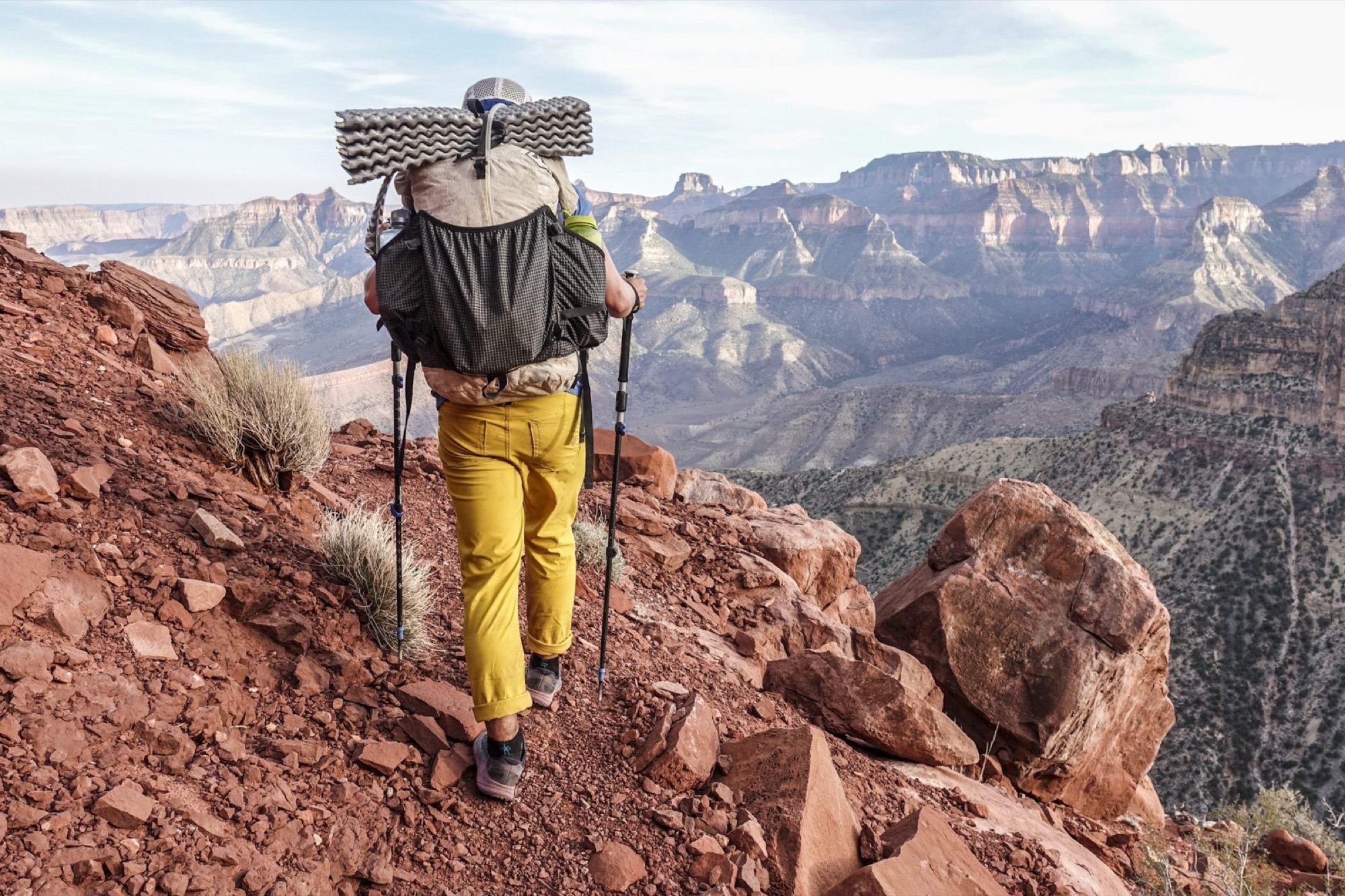
Crossing the Grand Canyon on foot, rim to rim, is a demanding desert backpack and one people tend to underestimate. The full route covers about 24 miles and roughly 10,000 feet (3,000 m) of total elevation change: nearly 6,000 feet (1,800 m) down from the North Rim to the Colorado River, then about 4,400 feet (1,300 m) back up to the South Rim. We spread it over three days on trail, which leaves time to actually look around instead of just pushing through.
This handbook is your one stop resource for getting ready: training, gear, food, the daily plan and the questions people ask most. Read it start to finish, then keep it on hand as you pack and train. We always try to give you clear, accurate information, but we’re not infallible. If anything here is unclear or looks wrong, tell us at [email protected].
Your one-page checklist
If you read nothing else, read and act on this.
- Training completed. Cardio and strength, well before departure. This trip is harder than it looks on paper, and it’s one of our most frequently underestimated itineraries.
- Travel to Kanab arranged. Know your arrival time; plan to be there by 4pm on Day 1 for the welcome dinner. Kanab is about 3.5 hours by car from Las Vegas, with a one hour time change.
- Rescue insurance obtained and proof sent to us. It’s mandatory. See Insurance requirements below.
- Gear packed. Check it against the gear list and sort out rentals early.
- Trail snacks sorted. We cover trail meals, but you bring your own snacks: about half a pound to a pound per day.
- Personal medications and a small first aid kit ready. Blister care and anything you need for five days.
- Sense of humor and team spirit packed. You’ll want it on the climb out.
About AWExpeditions
AWExpeditions was born out of a simple idea: to create space for women in mountaineering and backcountry travel. Historically, men have led most of the field, leaving women with fewer opportunities to lead, learn and thrive in these environments. AWE exists to flip that script.
We work together. We lift one another up. We show up for ourselves and for our teammates when things get difficult, and we’re prepared and flexible when the trail asks for it. Diversity is our strength, and it guides how we approach our teammates, guides, staff and local partners. Creating a safe space for everyone is at the heart of what we do.
About your guides
This trip runs with our local partner, Dreamland Safari Tours, based in Kanab. Your leadership team typically pairs an AWE expedition leader with one or more local women guides who know the canyon’s trails, water sources and seasonal conditions. Guide assignments vary trip to trip; we’ll introduce you to your specific guide team in the weeks before departure.
Training
This isn’t a trip to tackle with untrained legs. An unprepared hiker affects the whole team’s pace, and the climb out on the last day, 9.5 miles and about 4,400 feet (1,300 m), is hard. Start training well in advance.
Train for both endurance and strength, with real attention to the downhill: lunges and other leg strength work matter as much as cardio, since the first days are a long, steady descent that’s tough on the knees. Hike on rugged terrain with a weighted pack as often as you can. As a baseline, aim to be able to run a trail half marathon or complete a 12-plus mile day hike carrying 40 pounds without feeling done in at the end.
AWE partners with Uphill Athlete, widely regarded as the gold standard for mountaineering fitness, at special pricing for AWE climbers. Their Beginner Mountain Fitness plan is a good fit even though this isn’t technical mountaineering: it’s built for exactly this kind of multi-day, pack-carrying effort.
Daily itinerary
Weather, team pace and permit-assigned campsites can all move this around, and the crossing direction (North to South or South to North) depends on which permits we’re issued. Your guides make the calls that matter.
| Day | Plan |
|---|---|
| 1 | Arrive in Kanab by 4pm; gear check, briefing and welcome dinner |
| 2 | Transfer to the trailhead; descend into the canyon, about 7 miles and up to 4,500 ft (1,400 m) of descent |
| 3 | Across the canyon, up to 12 miles with 2,000-plus feet of elevation change |
| 4 | Climb out, about 7 to 9 miles and up to 4,500 ft (1,400 m) of ascent; transfer back to Kanab for showers and a celebration dinner |
| 5 | Depart |
Route and elevation
The chart above shows the classic North-to-South crossing. The real shape of this trip is two big vertical days bookending one long traverse near the bottom:
- North Rim (8,241 ft / 2,512 m) to Cottonwood Camp (about 4,080 ft (1,240 m)). About 4,200 ft (1,300 m) of descent over roughly 7 miles on the North Kaibab Trail, the first trail day.
- Cottonwood Camp to the Colorado River and Bright Angel Campground (about 2,480 ft (760 m)). A further descent of roughly 1,600 ft (500 m), reaching the lowest point of the trip.
- Bright Angel Campground to the South Rim (6,860 ft / 2,090 m). About 4,400 ft (1,300 m) of climbing over 9.5 miles on the Bright Angel Trail, the hardest single day of the trip.
If permits put your team on the route in the other direction, or on an alternate route below the rim due to trail closures, the same elevation swings apply in reverse or in a different combination. We’ll confirm your specific plan once permits are in hand.
Trail progress checkpoints
Because this trip is so often underestimated, we use progress-based turnaround checkpoints on the descent, on the first trail day. If you don’t reach a checkpoint within the maximum time, your guides have the authority to turn you around and return you safely to the trailhead for your own safety and the team’s.
| Checkpoint | Distance | Vertical change | Maximum time |
|---|---|---|---|
| North Kaibab: Supai Tunnel | 1.7 mi | 1,440 ft (440 m) | 1 hr 30 min |
| South Kaibab: Cedar Ridge | 1.5 mi | 1,140 ft (350 m) | 1 hr 15 min |
| Bright Angel: 1.5 Mile Resthouse | 1.5 mi | 1,120 ft (340 m) | 1 hr 15 min |
These times aren’t a sprint and aren’t set for elite athletes. They’re a safety net that lets your guides assess pace and condition in the field, and they’re part of why training ahead of time matters. If you’re turned around, we get you safely back to town, but you’re responsible for any costs from the early exit (lodging, shuttles, rebooked travel), and no partial refunds are issued for an early turnaround.
Food on the trail
On a typical day you’ll hike 7 to 12 miles with a 30 to 35 pound pack and burn an estimated 3,000-plus calories, depending on your size and pace. We cover trail breakfasts, lunches and dinners, built around real food: warm granola or oatmeal, hearty dinners like chicken pesto ramen or Mexican rice bowls, and simple packable lunches (a wrap, a protein source and a cheese snack).
Snacks are not provided. Bring about half a pound to a pound of your own trail snacks per day, roughly 1,000 calories, since you’ll want something at every packs-off break. We can accommodate vegetarian, gluten-free, dairy-free and vegan diets with advance notice.
Gear
Everything here is required unless we’ve told you otherwise. Rentals are available through Dreamland Safari Tours for the big-ticket items (tent, sleeping bag, sleeping pad, trekking poles); ask us early so we can help arrange it.
- 50 to 65 liter pack
- Sleeping bag rated 20°F
- Sleeping pad
- Warm down layer
- Wind and rain jacket
- Trekking poles
- Cup, bowl and spoon
- Hiking boots or trail runners
- 3 liters of water capacity (hard-sided bottles, not a reservoir, so you can track your intake)
Your pack will be heavy no matter how carefully you pack: a one-person tent, water, your share of group food and kitchen gear, your own pack, bag and pad already add up to around 22 pounds before clothing, snacks or a hygiene kit. Keep careful with everything else and you should land around 35 pounds total.
What’s included and what isn’t
Included:
- Hotel nights in Kanab (double occupancy)
- Transport between the hotel and the trailhead
- Breakfasts and dinners in town
- All meals on the trail, with water, coffee, tea and hot chocolate
- A one-person tent and trekking poles
- Women guides from Dreamland Safari Tours who know the route
- Team gear: cooking gear, team medical kit, radios, GPS tracking
Not included:
- Travel to Kanab (rental car or car-pooling recommended)
- Lunches in town
- Tips for guides
- Personal gear, including your sleeping bag and pad
- Personal medications
- Trail snacks
- Medical, travel and rescue insurance
Price: $2,195 per person, plus 8.45% sales tax and a 3% public land use fee.
Insurance requirements
Preparing for a big adventure means planning for the unexpected. There are two kinds of relevant insurance: travel insurance and rescue (evacuation) insurance. Rescue insurance is mandatory. Travel insurance is highly recommended but your own decision.
Travel insurance. What happens if you sprain an ankle the week before your trip, your car breaks down, or your checked bag with all your gear doesn’t arrive on time? We’ve seen all of those scenarios happen. We don’t have a preferred provider, but consider a Cancel For Any Reason policy, which typically lets you recoup your trip fees and travel costs even if you have to cancel for a reason like a job change or a family matter. We don’t require proof of travel insurance; it’s your own decision.
Rescue insurance. In the event of an emergency, you need coverage that includes helicopter evacuation to avoid the high costs of a rescue operation in the canyon. Global Rescue is a trusted leader in mountaineering and backcountry travel protection, with comprehensive policies that include both travel and rescue coverage. For a more affordable, basic option, consider joining the American Alpine Club; partner-level membership includes up to $7,500 in trailhead rescue benefits, which satisfies the rescue insurance requirement for this trip, though it isn’t as comprehensive as a dedicated policy. We do require proof of rescue insurance: please send your policy details to [email protected] before the trip. If you’d rather not carry rescue insurance, you can sign a coverage waiver instead; contact [email protected] to arrange it.
Questions? Get in touch.
[email protected] · 833-252-5293 Sunny Stroeer, Founder and Expedition Leader: [email protected] Shea McCrary, General Manager: [email protected]
Frequently asked questions
How fit do I need to be?
Comfortable with 7 to 10 miles a day on rough trail. Train for strength as well as cardio: the climb out on the last day is 9.5 miles with about 4,400 feet (1,300 m) of climbing. As a baseline, you should be able to run a trail half marathon or complete a 12-plus mile day hike with 40 pounds on your back without feeling wrecked at the end.
How hard is it?
The full crossing is about 24 miles: nearly 6,000 feet (1,800 m) down from the North Rim and about 4,400 feet (1,300 m) up to the South Rim. With training it's very doable, and spreading it over three days on trail makes a real difference.
How much will I carry?
Around 35 pounds, including about 5 pounds of team gear. There are no porters on this route.
When will my dates be confirmed?
When the National Park Service issues our permit. Permits for May trips are decided in January, and for September and October trips in May. We'll tell you as soon as we have yours. Please don't book flights before then.
Are the trails open?
Not all of them right now. A flash flood on August 29, 2026 closed the North Kaibab Trail, Phantom Ranch and Bright Angel Campground, and the Park Service hasn't given a reopening date. Our fall 2026 teams ran an alternate route below the rim. For 2027 we'll run the full crossing if the trails reopen, and otherwise the best open route below the rim. We'll tell you which route your team has as soon as we know.
Which direction do we cross?
Depending on permit and campsite availability, we may cross North to South or South to North. Daily mileage depends on which campsites we're assigned. We'll confirm your specific itinerary once we have permits in hand.
What if it rains?
Our guides watch the forecast before the trip. We hike in rain when it's safe, and we'll tell you well ahead if the trail or route needs to change.
What's the closest airport?
St. George is about 1.5 hours from Kanab. Most people fly into Las Vegas, 3.5 hours away, and rent a car. Salt Lake City is about 5 hours.
Will I be sharing a tent?
No. We provide a free-standing, one-person backpacking tent for everyone, so you have your own space.
Where do we go to the bathroom?
There are no outhouses below the rim in most sections, so waste gets packed out to protect the canyon. Your guides will give you the kit and walk you through it before you need it.